






Technology partner for a future-proof administration
SUSE was founded in 1992 in Germany and is today the leading European open-
source provider. For more than three decades, we have been supporting institutions at all levels of administration in their tasks.
01
Become Digitally More Sovereign
With solutions from SUSE, you retain full control over sensitive data and overcome the risks of vendor lock-in. Our open-source technologies offer you flexible choices and thus pave the way toward a sovereign digital administration.
02
Strengthen Cyber Resilience
The threat landscape for IT security has worsened significantly in recent years. Administrative institutions in particular are increasingly becoming the target of cyberattacks. SUSE enables you to build resilient IT infrastructures in order to reliably defend against growing dangers.
03
Accelerate Innovations
SUSE offers you the technologies to provide new digital administrative services more quickly. Authorities use our solutions for purposes including the modernization of existing specialist procedures, the development of trustworthy AI applications, and the operation of smart edge infrastructures.
"Open by design, sovereign by choice": Digital Sovereignty with SUSE
Our understanding of Enterprise Open Source stands under the motto "Open by
design, sovereign by choice". We consistently rely on open standards, transparent
development, and true freedom of choice. For our customers in the public
administration sector, this means: maximum control over the systems and support
processes used, without hidden dependencies.

Data Sovereignty
Take back control of your data—from storage location and encryption to access rights. This makes it easier to fulfill data protection, compliance, and security requirements when processing sensitive information.
Operational Sovereignty
Ensure the reliable operation of your digital services even in crisis situations or during external changes. Reduce critical dependencies and manage the support and governance of your IT environment according to your own guidelines.
Technological Sovereignty
Design your digital infrastructure flexibly and independently of individual manufacturers or proprietary platforms. Open Source software creates transparency, adaptability, and freedom of action in the further development of your IT.

Jürgen Backes | Head of the Open Source Department (Municipal Data Center Niederrhein), KRZN
"Open Source technologies and especially the solutions from SUSE are a critical
building block for our digital sovereignty. The majority of our systems run on Linux today—and with SUSE Rancher Prime, we can also securely and sovereignly deploy modern, containerized applications for municipalities, schools, and other public institutions."
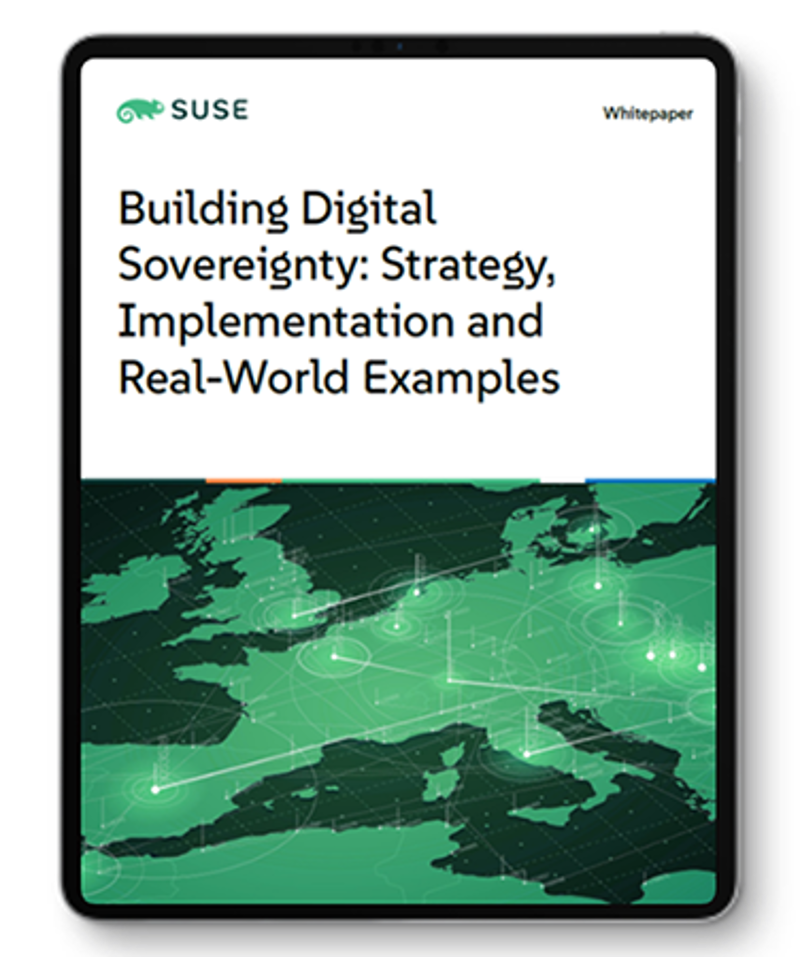
Implementing Digital Sovereignty Strategically:
A Guide with Practical Examples
In this whitepaper, you will learn:
- How the three levels of digital sovereignty interact
- What the success factors for a successful sovereignty strategy are
- Which three measures you should ideally tackle right away
Cyber Resilience in the Public Sector
Cyberattacks and hybrid operations are often targeted specifically at state
institutions. Therefore, the public sector must do more to protect its digital
infrastructure. However, individual security solutions often fall short. To sustainably
strengthen cyber resilience, public administration needs a holistic strategy.
1
Zero Trust Principle
The Linux and container management platforms from SUSE support Zero Trust concepts through integrated policy mechanisms, granular access controls, and workload-level segmentation. This allows access to sensitive data to be comprehensively secured and attacks to be contained early.
2
Hardened Linux Base
SUSE Linux Enterprise Server has been certified by the Federal Office for Information Security (BSI) according to Common Criteria EAL 4+. This certification confirms that SLES has proven security functions required for critical infrastructures.
3
Cloud Resilience
With solutions from SUSE, organizations can securely move workloads between different on-premises and cloud environments without having to customize the application code. This reduces lock-in risks and makes it easier to react to regulatory changes or new risk scenarios.
4
Controlled AI Usage
With SUSE AI, authorities can build a Zero Trust platform for deploying trustworthy, AI-supported specialist procedures and applications. Observability and security functions help enforce guardrails for AI usage and stop unauthorized AI calls. This ensures data processing is traceable at all times, as required by the EU AI Act.
5
Edge Resilience:
Hybrid threats often target critical infrastructures such as energy supply and public transit. SUSE protects these distributed environments with hardened Linux and container platforms. SUSE Edge enables the central control of thousands of systems while ensuring that each location can operate autonomously in an emergency.
6
Secure Software Supply Chains:
With the SUSE Application Collection, SUSE provides verified application images that
are systematically tested and scanned for security vulnerabilities. Particularly with regard to specifications such as BSI TR-03185-2, NIS-2, and the EU Cyber Resilience Act, this structured approach is gaining importance. A secured software supply chain minimizes attack surfaces and creates the foundation for verifiable
IT security.
“SUSE Rancher Suite allows us to create new workflows in the way we want and not be forced into a box. This change has been so positive that we are now working with other municipalities to help them do the same.”
Sander de Rijk
Cloud Consultant
Municipality of Eindhoven

Learn more about our solutions for public administration
SUSE Linux Enterprise Server
A reliable, scalable, and secure server operating system designed for business-critical workloads.
SUSE Rancher Prime
The Kubernetes management platform supports the development, deployment, and
management of containerized specialist procedures and applications.
SUSE Multi-Linux Manager
SUSE Multi-Linux Manager enables the management, monitoring, and automation of hybrid and heterogeneous Linux infrastructures from a single console.
SUSE Virtualization
The hyperconverged infrastructure solution based on the open-source project Harvester merges virtualization and container orchestration into a single platform.
SUSE AI
SUSE AI is a cloud-native platform for deploying, managing, and running scalable and trustworthy AI-powered business applications.
SUSE Edge
SUSE Edge enables the management of the entire lifecycle of edge devices. The platform can be easily customized to support use cases across various industries.
Blog
Workload Repatriation Is a Resilience Strategy, Not an IT Project